Call us on +44(0)7763 572224

The ‘Second-Home’ Effect: How Serviced Accommodation Improves Productivity on UK Assignments

The ‘Second-Home’ Effect: How Serviced Accommodation Improves Productivity on UK Assignments
Most productivity advice for travelling employees misses the obvious. People do not struggle on long assignments because the work is hard. They struggle because the place they are sleeping does not feel like anywhere. They cook badly, sleep worse, and treat the calendar as a countdown rather than a routine. By week three, the project suffers, and nobody quite knows why.
That gap between “fine” and “settled” is what the serviced accommodation industry calls the second-home effect. It is harder to measure than a hotel rate, easier to spot in work output, and the single biggest reason HR and procurement teams who understand it stop assigning long-stay assignees to hotel rooms.
What the first two weeks actually look like
Relocating employees rarely say what their managers want to hear in the first two weeks of an assignment. They say the place is fine. The Wi-Fi works. The kitchen is small but functional. What they mean, usually, is that they have not yet found their rhythm. The apartment is a stop, not a base. They are living out of a suitcase and treating the location as temporary even when the assignment is six months long.
Hotels make this worse. A hotel room, however well appointed, sends a clear message: you are passing through. The bed folds down, the curtains do not quite block the dawn, the wardrobe is too small for a week, never mind a quarter. People manage. They also produce less, sleep worse and call home more often. The cost shows up not on the expense claim but in the work output.
Why the apartment format lifts output
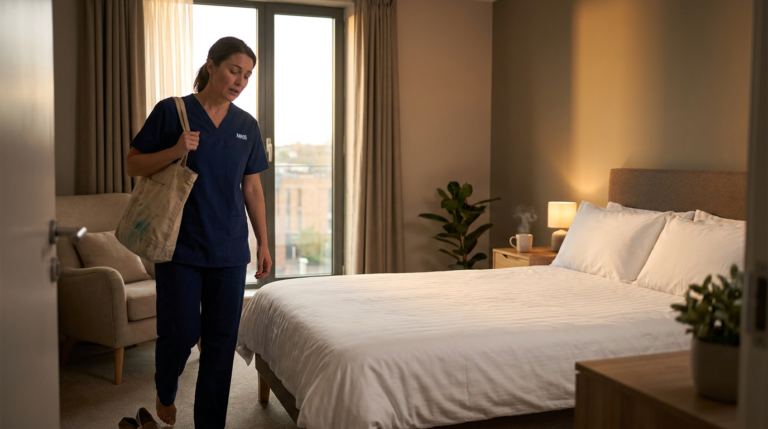
Serviced accommodation changes the equation in a way that is harder to measure but easy to feel. The Independent Review of the Role and Value of Serviced Apartments in the UK describes the model as offering “a home away from home” with separate work and relaxation zones, a proper kitchen and the kind of storage that lets an assignee actually unpack. People settle faster. They cook. They exercise. They sleep.
Three features matter more than the rest. First, the kitchen. Self-catering is not a lifestyle preference for most travelling professionals; it is a budget and a health choice. Cooking at home cuts the daily food bill meaningfully and removes the working-lunch rut that drags energy down by week three. Second, the workspace. A real desk, a proper office chair and reliable broadband transform the apartment from a place to sleep into a place to work. Hotel rooms, with their decorative desks and bedside lamps, do not. Third, the bedroom-and-living-room split. The human brain does not transition well between sleep and wake states in a single room. A separate living space, however compact, signals the end of the working day and makes a proper wind-down possible.
The productivity research on this is more consistent than procurement teams often realise. Studies cited in relocation and mobility literature consistently find that assignees in serviced apartments report better sleep quality, higher satisfaction with their assignment and stronger intention to extend or accept follow-on moves, compared to those placed in extended-stay hotels. Employers see lower early-return rates and fewer mid-assignment escalations. The patterns are small in any single case but compound quickly across a programme.
The home-office question
Hybrid working has reshaped what business travellers expect from a temporary base. The pattern is now familiar: an assignee arrives on a Sunday, joins project calls on Monday morning and treats the apartment as a satellite office for the rest of the month. A hotel that charges extra for premium Wi-Fi, lacks a desk suitable for a multi-hour video call, and has poor lighting for camera work becomes an active obstacle to productivity.
Serviced apartments in the UK have caught up with this shift faster than most operators expected. Strong broadband, dedicated desks, monitor-ready layouts, ring-light-friendly lighting and quiet zones for calls are now standard in many professionally managed units. The market data backs this up: STR’s UK occupancy figures for serviced apartments have consistently exceeded hotels in recent reporting, and average rates have risen as the corporate and business traveller share of revenue has grown.
What HR and mobility teams see in practice
For HR leaders managing UK relocations, the second-home effect shows up in three places: assignment completion rates, employee Net Promoter Score on the housing element, and the number of mid-stay moves requested. Well-managed serviced accommodation reduces all three. It also tends to lift the candidate conversion rate for new hires who are weighing a relocation offer. People who are shown a real apartment with a kitchen and a separate bedroom accept faster than those shown a hotel room with a longer stay attached.
The onboarding benefit matters too. An assignee who can unpack, host a video call and cook a familiar meal on day one is several days ahead of one who has to find a supermarket, locate a suitable café and negotiate the room layout of an unfamiliar hotel. That time shows up in project timelines.
When the model does not hold
The second-home effect is real, but it is not automatic. A serviced apartment that is poorly furnished, badly cleaned or in a noisy location can feel more like a hostel than a base. The model depends on operator quality. Buyers should expect consistent standards across a portfolio, not just on the units the sales team shows first.
The same is true for assignments shorter than a week. A two-night project trip does not benefit from a fully equipped apartment. It costs more in setup and feels over-engineered for the use case. Hotels still own that segment.
A practical filter for your next UK assignment
If your team is placing someone for four weeks or longer, ask the serviced accommodation provider to walk you through three things: the workspace setup, the kitchen inventory and the building’s noise profile at the hours your assignee will be working. If the answers are clear and the unit is in a managed building, the second-home effect usually follows. If the operator cannot answer those questions, keep looking.
If you are running a UK relocation programme and want a second opinion on the housing element, our [services page]https://topstay.uk/services/ sets out how we help HR and mobility teams plan accommodation that actually supports output, and [getting in touch]https://topstay.uk/contact/ is the quickest way to talk it through with our team.
Internal links
- Topstay corporate housing services
- About Topstay and how we work with relocating teams
- Get in touch about a UK relocation programme
Sources
- An Independent Review of the Role and Value of Serviced Apartments in the UK (ASAP, 2024), https://theasap.org.uk/wp-content/uploads/2024/04/An-Independent-Review-of-the-Role-and-Value-of-Serviced-Apartments-in-the-UK-1.pdf
- Supporting Global Mobility: Service Accommodation for International Assignees (LinkedIn, 2025), https://www.linkedin.com/pulse/supporting-global-mobility-service-accommodation-bernard-audemard-yrk6e
- Accommodation for relocating staff: 2026 HR guide (Jigsaw Conferences), https://jigsawconferences.co.uk/articles/accommodation-for-relocating-staff-2026-hr-guide
- Why Corporate Tenants Are Pivoting to Service Accommodation (LinkedIn, 2025), https://www.linkedin.com/pulse/why-corporate-tenants-pivoting-service-accommodation-over-audemard-qibde
- Here to stay (Business Travel Magazine), https://thebusinesstravelmag.com/here-to-stay/
- The Complete Guide to Serviced Apartments in London (2026 Edition) (Checkin Apartments), https://www.checkinapartments.com/blog/the-complete-guide-to-serviced-apartments-in-london/
- Corporate Housing UK: Complete Guide for Businesses (Overnightly, 2026), https://overnightly.com/blog/corporate-housing-uk-complete-guide
- Corporate Housing UK, All Bills Included (Overnightly), https://overnightly.com/corporate-housing