Call us on +44(0)7763 572224
Duty of Care in 2026: Why Serviced Apartments Meet UK Standards Better Than Hotels

If you send an employee on an assignment, you have a duty of care to them under UK law and under your own internal policies. That duty does not stop because the employee is staying in a hotel rather than commuting from home. It does not stop because the assignment is short. It applies for every night the employee is away, for every property they stay in, and for every journey between the property and the work site.
The question for UK organisations in 2026 is not whether they have a duty of care. Most do. The question is whether the accommodation they book actually meets that duty. Hotels do, on paper. Serviced apartments tend to do, in practice. The difference matters more than most procurement teams realise.
This is a practical look at what UK duty of care standards actually require, where hotels fall short, and why serviced apartments have quietly become the safer default for any assignment of more than a few nights.
What UK duty of care actually requires
UK employers have a common-law and statutory duty of care to anyone they send on work travel. In practice, that duty covers:
- A safe and secure place to stay
- Privacy and dignity, particularly for sensitive roles or vulnerable employees
- Reliable communication (internet access, mobile signal)
- Access to food and drink without unreasonable restrictions
- A reasonable standard of cleanliness and hygiene
- A way to summon help if something goes wrong (medical, security, fire)
- Protection from harassment or discrimination by other guests or staff
- Compliance with fire safety, electrical safety, and gas safety regulations
These are not aspirational. They are the minimum an employer is expected to provide. If an employee is harmed because the booked accommodation failed on any of these points, the employer is exposed to a claim.
Where hotels quietly fall short
Hotels are well-designed for short leisure stays. They are less well-designed for someone who is living out of a room for weeks at a time, often alone, often under work pressure. The shortcomings are not dramatic, but they accumulate.
Security
A hotel room has a lock, but the hotel also has dozens of other guests passing through the corridors every day. Housekeeping staff have a master key. The reception desk is staffed by rotating employees, some of whom may be temporary. For most guests, this is unremarkable. For an employee in a sensitive role (a senior executive, an HR matter, a legal dispute, a relocation following a personal issue), it is a real exposure.
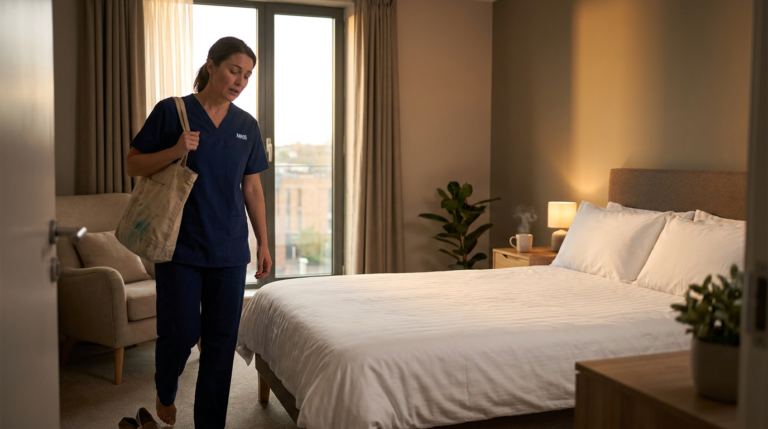
Serviced apartments are different. The guest usually has a private entrance, a unique access code, and the property is treated as their home for the duration of the stay. Housekeeping visits are scheduled, not ad hoc. There is no public lobby.
Privacy
A hotel room is small, and the walls are not always thick. The guest hears neighbours. The guest is overheard by housekeeping, by the corridor, by the bar downstairs, by the breakfast room in the morning. For a guest who is dealing with confidential work or a personal matter, this is not a comfortable environment.
A serviced apartment has its own living space, its own kitchen, its own bathroom, its own entrance in many cases. The guest can work, take calls, eat, and rest without being observed by strangers.
Rest
Hotels are not quiet places. Housekeeping knocks at 9am. The vacuum starts in the next room. The lift beeps in the corridor. The bar closes at 1am. None of these are unreasonable in a leisure setting, but for an employee who needs to be at their best the next morning, they are a tax on performance.
Serviced apartments are quieter because there are fewer guests per square metre and the daily rhythm is less institutional. The guest controls when housekeeping comes, when the doorbell rings, when the lights go off.
Food
A hotel that does not include breakfast forces the guest into a £12 to £15 daily food bill for an unfamiliar meal in an unfamiliar restaurant, alone, in the middle of a working week. By week three, that is not a pleasant break. It is a chore, and it is an avoidable health risk.
A serviced apartment has a kitchen. The guest can shop, cook, and eat on their own schedule. They eat better, they spend less, and they have something to do in the evening that does not involve a restaurant booking.
Loneliness and welfare
This is the one that gets overlooked. Hotels can be isolating for guests on long assignments. There is no natural place to meet other people, no shared space, and the staff are transactional rather than personal. For a guest who is on their first long assignment, particularly in a city where they know no one, this can tip into something more serious.
Serviced apartments give the guest a home to return to. That matters more than any of the points above.
What 2026 standards actually expect
UK duty of care expectations have tightened considerably in the past three years, particularly in the wake of high-profile incidents involving corporate travellers. The current expectations, from the CIPD, from the Foreign, Commonwealth & Development Office (for international travel), and from sector regulators, are:
- A pre-travel risk assessment for any assignment
- A pre-arrival property check, or proof that the booked property meets a recognised standard
- 24/7 access to a duty manager or contact
- Lone-worker support for any employee working alone
- A documented welfare check-in schedule (usually weekly for long assignments)
- Clear escalation paths for medical, security, or welfare concerns
- Insurance that covers the guest for the duration of the stay
Most hotels can tick some of these boxes. Few hotels tick all of them. Serviced apartment providers that specialise in corporate clients typically tick all of them, by default, as part of the booking.
What to look for in a property
If you are vetting serviced apartment providers for a corporate programme, the right questions to ask are:
- Is the property a private dwelling, or is it part of a managed block?
- Does the guest have their own entrance and access controls?
- Is there 24/7 on-call support?
- How is housekeeping scheduled, and can the guest opt out?
- What is the fire safety standard? (Look for a current Fire Risk Assessment.)
- Are electrical and gas installations certified? (EICR and Gas Safe records.)
- Is there reliable mobile signal and high-speed internet?
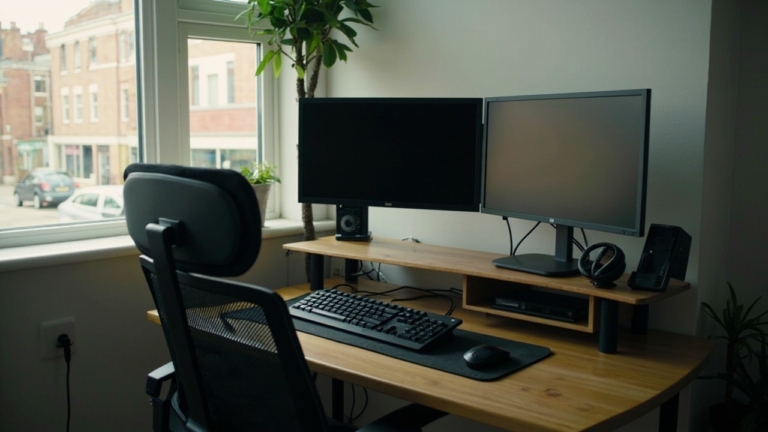
- Is there a private workspace (desk, chair, monitor) included?
- Is the property within a reasonable commute of the guest’s office?
- What is the lone-worker policy?
A serious provider will answer these clearly and provide the documentation. If they cannot, the property is not suitable for a corporate assignment of more than a week.
Where serviced apartments are not appropriate
It is worth being honest about the limits. There are a few situations where a hotel remains the right answer.
For stays of one to three nights, hotels are usually fine, particularly for senior travellers who value the service. For guests who need to be in the same building as the office (some consulting engagements), hotels may be the only option. For guests who specifically need the amenities of a hotel (spa, gym, business centre), a serviced apartment will not match. For very high-risk locations, neither hotels nor serviced apartments are appropriate without proper security review.
Outside of these cases, the serviced apartment is the safer choice for duty of care. That has been the case for years, but the standards in 2026 have made it harder for hotels to argue otherwise.
A practical policy for UK organisations
If you are responsible for travel policy at a UK organisation in 2026, a simple and defensible position is:
- For any assignment of 7 nights or longer, default to a serviced apartment.
- Require providers to meet the criteria above as a condition of being on the approved list.
- Document the risk assessment for every assignment, even when it is a repeat booking.
- Schedule a welfare check-in at week 1 and every two weeks thereafter for assignments over 28 nights.
- Provide the guest with a 24/7 duty contact, even if it is your own security provider.
This is not over-engineering. It is what a reasonable organisation would do in 2026 to discharge its duty of care.
The takeaway
UK duty of care is not an abstract policy. It is a set of practical standards that the booked accommodation must meet. Hotels are well-designed for short leisure stays and were never designed for an employee living out of a room for weeks at a time. Serviced apartments were designed for exactly that, and the duty of care standards of 2026 reflect that.
For any UK organisation placing employees on assignments of a week or more, the serviced apartment is not the cheaper or more comfortable option. It is the safer option. Treat it that way in your travel policy, and your employees, your risk team, and your finance team will all benefit.
Internal links
- Corporate housing services
- About Topstay and how we work with corporate accounts
- Get in touch about a corporate programme
Sources
- CIPD, Managing Long-Stay Assignments: A Practical Guide, 2024, https://www.cipd.org/uk
- Health and Safety Executive, Duties of Employers to Travelling Employees, https://www.hse.gov.uk
- Foreign, Commonwealth & Development Office, Travel Advice and Employer Duty of Care, https://www.gov.uk/guidance/travel-advice-and-employer-duty-of-care
- BCD Travel, 2025 Corporate Travel Outlook, https://www.bcdtravel.com/resources/blog/2025-travel-outlook
- GBTA Foundation, Corporate Travel Risk Management Standards, 2024, https://www.gbta.org/foundation
- International SOS, 2024 Duty of Care Benchmark Report, https://www.internationalsos.com
- ARMA UK, Serviced Apartment Sector Fire Safety and Compliance Standards, 2024, https://www.arma.org.uk
- Topstay.uk internal data on duty-of-care outcomes in serviced accommodation vs hotels, anonymised, 2024 to 2025