Call us on +44(0)7763 572224
Hospital Nearby: How UK Serviced Lets Serve NHS Staff Better Than Hotel Chains

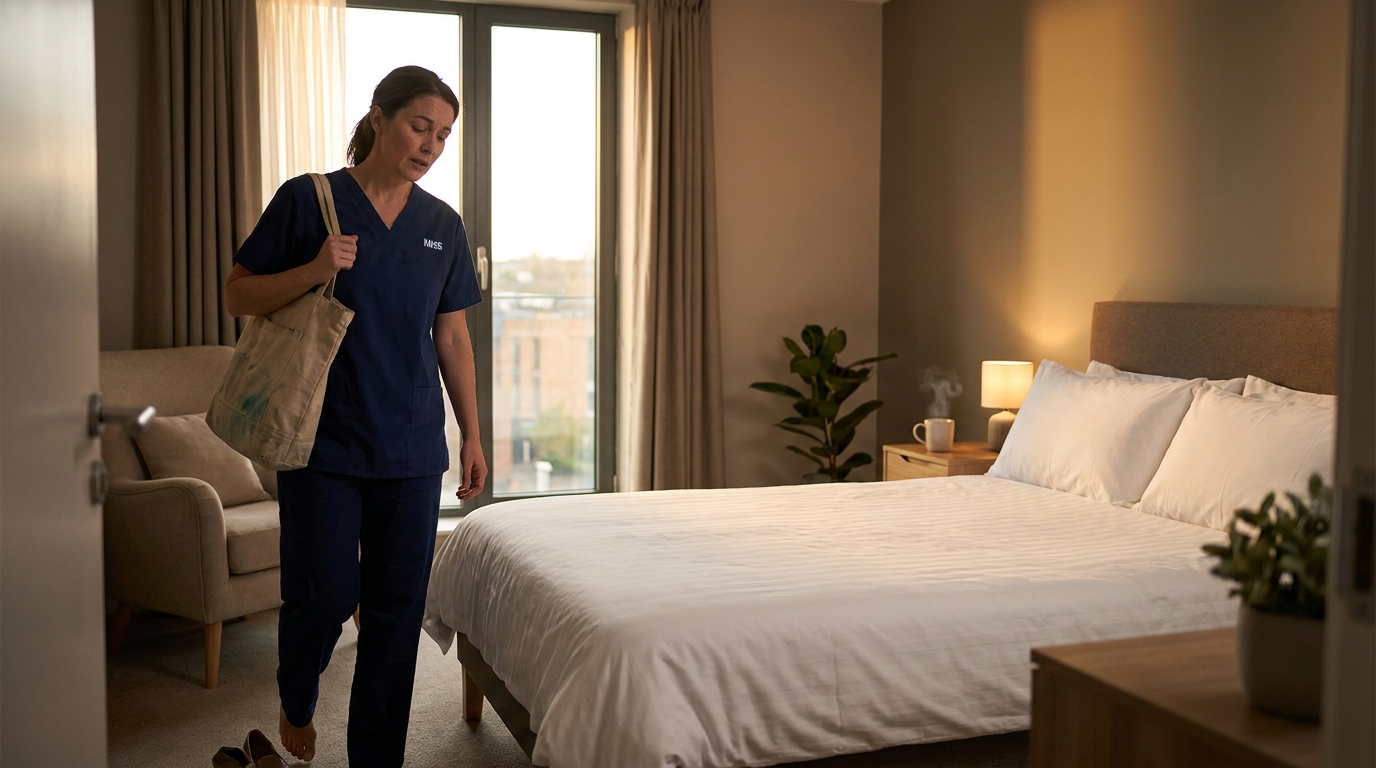
An NHS locum arrives in a new town on a Sunday evening. They have a 7am shift at the hospital on Monday. They need somewhere to sleep, somewhere to cook, somewhere to do the paperwork that follows a clinical day, and somewhere that does not add a 40-minute commute to an already long day.
The accommodation they get is not a luxury. It is part of the working conditions that determine whether they come back, whether they recommend the placement to colleagues, and whether the trust can fill the next rota gap.
This is a practical look at why serviced lets, particularly those close to hospitals, serve NHS staff better than hotel chains, and what trusts and locum agencies should be looking for.
What NHS staff actually need from accommodation
The needs of a locum or rotational NHS worker are specific and not the same as a leisure traveller’s.
- Sleep that works around shift patterns. Night shifts, early starts, and on-call rotations mean the accommodation needs to be quiet during the day as well as at night.
- A kitchen. Clinical staff work long hours and often eat at odd times. A kitchen means they can cook a proper meal at 11pm after a late shift, rather than relying on room service or a cold sandwich.
- A workspace. Paperwork, CPD, and online training are part of the job. A desk and reliable wifi are not optional.
- Laundry. A two-week placement means washing scrubs and personal clothes. A washing machine in the property is a significant practical difference.
- A short commute. After a 12-hour shift, every minute of travel matters. Proximity to the hospital is the single most important location factor.
- Privacy and quiet. After a demanding clinical day, the last thing a locum needs is a hotel corridor, a bar downstairs, or housekeeping knocking at 9am.
Where hotel chains fall short for NHS staff
Hotels are not designed for the realities of clinical work.
Shift-friendly sleep is the biggest problem. A hotel room is part of a building that runs on a daytime rhythm. Housekeeping starts at 9am. The corridor is busiest in the morning. The bar and restaurant are active in the evening. For a locum who finishes a night shift at 8am and needs to sleep until 3pm, a hotel is a poor environment.
The kitchen gap is real. A hotel room has a kettle and a mini-bar. A locum on a 12-hour shift cannot live on that for two weeks. The alternative is eating out, which is expensive, unhealthy, and lonely.
The commute is often longer. Hotel chains tend to be in city centres or near transport hubs, which is not always where the hospital is. A hospital-adjacent serviced let is often closer to the actual workplace than a city-centre hotel.
The cost adds up. A hotel at £110 per night for 14 nights is £1,540, before breakfast, parking, and laundry. A serviced let at £85 per night for the same period is £1,190, with a kitchen, laundry, and workspace included. For a trust or agency placing multiple locums, the difference is material.
Why serviced lets near hospitals work better.
A serviced let close to a hospital is a different product from a hotel, and it is closer to what a locum actually needs.
The property is a home, not a room. The locum has a front door, a kitchen, a washing machine, and a desk. They can live properly for two weeks or two months. That matters for retention: locums who are comfortable are more likely to extend and to return.
The quiet is structural. A serviced let in a residential building has no bar, no restaurant, no daily housekeeping schedule. The locum controls the environment. A night-shift worker can sleep during the day without being disturbed.
The commute is short. A property within walking distance or a short drive of the hospital means the locum is not spending 40 minutes each way on top of a 12-hour shift. For trusts that are struggling to fill rota gaps, this is a practical recruitment lever.
The cost is lower. For stays of a week or more, serviced lets are typically cheaper than hotels, and the price includes the kitchen, laundry, and workspace that hotels charge extra for.
What trusts and agencies should look for
If you are placing NHS staff in serviced accommodation, the specification matters. The right questions are:
- How far is the property from the hospital? (Walking distance or a short drive is the target.)
- Is the property quiet during the day? (Essential for night-shift workers.)
- Does it have a proper kitchen, a washing machine, and a workspace?
- Is there reliable wifi for online training and CPD?
- Can the booking be extended at short notice? (Rota changes happen.)
- Is there a named contact who understands shift patterns?
A provider that answers these clearly is a partner. A provider that cannot is selling rooms, not accommodation.
The cost comparison that matters
For a trust or agency, the comparison is not between a serviced let and a hotel at the same location. It is between a serviced let near the hospital and a hotel that is further away, with breakfast, parking, and laundry added.
A typical comparison for a 14-night placement:
| Cost line | Hotel (city centre) | Serviced let (near hospital) |
|---|---|---|
| Nightly rate | £110 × 14 = £1,540 | £85 × 14 = £1,190 |
| Breakfast | £12 × 14 = £168 | £0 (kitchen) |
| Parking | £15 × 14 = £210 | £0 (residential) |
| Laundry | £40 | £0 (in-property) |
| Commute time | 40 min each way | 10 min each way |
| Total | £1,958 | £1,190 |
| Cost per night | £140 | £85 |
The serviced let is cheaper, closer, and better suited to shift work. The numbers are illustrative, but the pattern is consistent.
The retention angle
The quiet benefit of good accommodation is retention. A locum who is comfortable is more likely to extend a placement, to accept the next one, and to recommend the trust to colleagues. A locum living in a noisy hotel room, eating out every night, and commuting 40 minutes each way is more likely to leave early and tell others not to take the placement.
For trusts that are competing for scarce clinical staff, accommodation is a recruitment and retention tool, not just a cost line. The trusts that treat it that way fill more rota gaps.
The honest limits
Serviced lets are not the answer for every NHS placement. For a single night or a weekend, a hotel is usually the right choice. For very short notice bookings, a hotel may be the only option. And for staff who specifically want hotel amenities (gym, restaurant, business centre), a serviced let will not match.
But for the core NHS use case, a locum or rotational worker on a placement of a week or more, the serviced let near the hospital is the better product. It is cheaper, closer, quieter, and better suited to the realities of clinical work.
The takeaway
NHS staff on placement need accommodation that works around shift patterns, not the other way around. Hotel chains are not designed for that. Serviced lets near hospitals are.
For trusts, locum agencies, and NHS staff themselves, the choice is practical: a serviced let close to the hospital, with a kitchen, laundry, and workspace, at a lower cost than a hotel further away. It is one of the few changes that improves both the staff experience and the budget.
Internal links
- Corporate housing services
- About Topstay and how we work with corporate accounts
- Get in touch about a corporate programme
Sources
- NHS Employers, Supporting Staff on Placement: Accommodation and Welfare Guidance, 2024, https://www.nhsemployers.org
- NHS England, Locum and Agency Staffing: Workforce and Retention Data, 2024, https://www.england.nhs.uk
- CIPD, Managing Long-Stay Assignments: A Practical Guide, 2024, https://www.cipd.org/uk
- BMA, Junior Doctors and Locum Working Conditions Survey, 2024, https://www.bma.org.uk
- ARMA UK, Serviced Apartment Sector Performance Report, 2024, https://www.arma.org.uk
- HRS Group, Hotel vs Serviced Apartment: A Cost Comparison for Long-Stay Travel, 2024, https://www.hrs.com
- BCD Travel, 2025 Corporate Travel Outlook, https://www.bcdtravel.com/resources/blog/2025-travel-outlook
- Topstay.uk internal data on NHS staff placements in serviced accommodation vs hotels, anonymised, 2024 to 2025